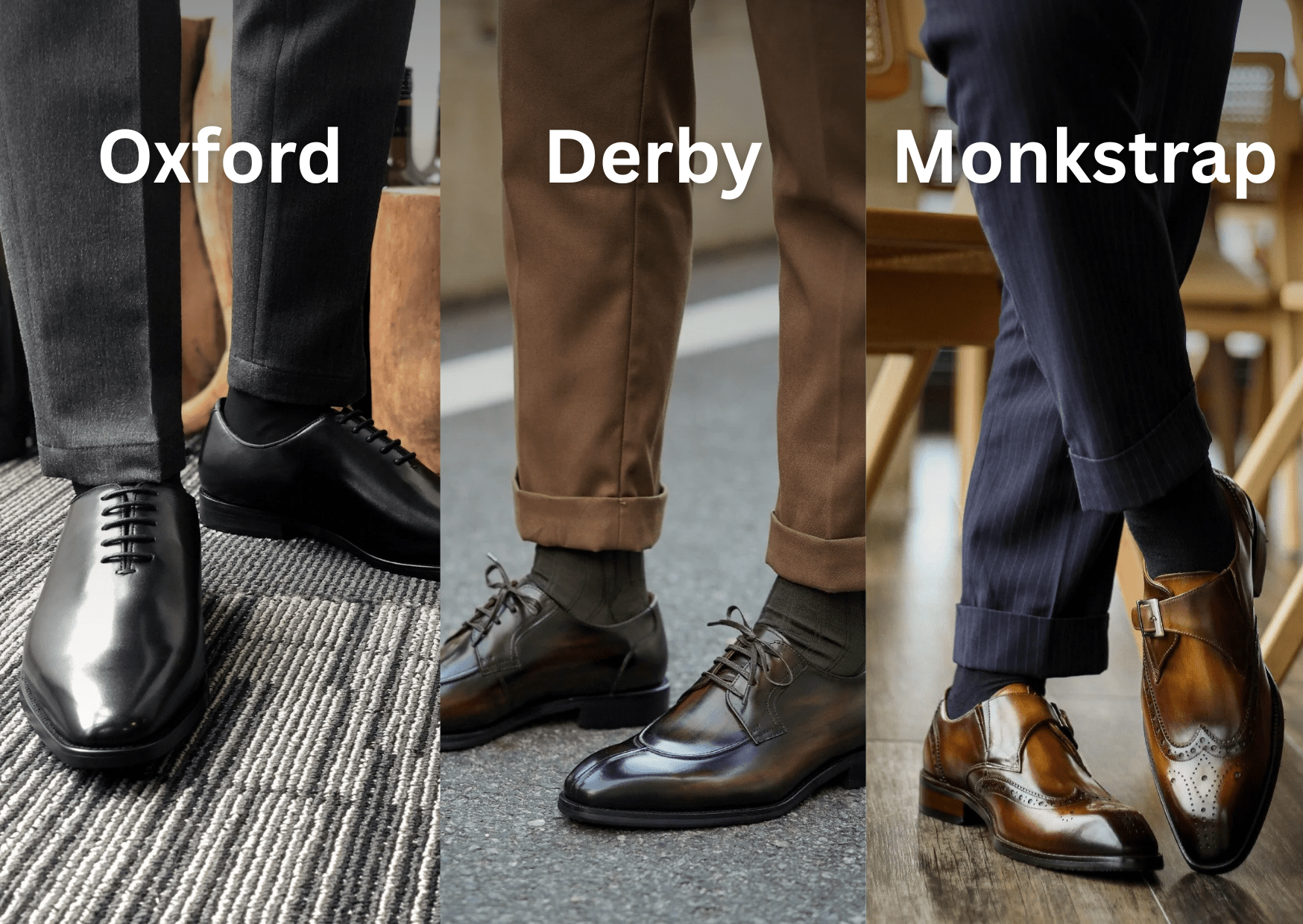
The short answer: an Oxford has closed lacing and is the most formal of the three. A Derby has open lacing, so it is slightly less formal, more forgiving on a wide foot or high instep, and the most versatile. A monk strap has no laces at all: a strap and buckle close it, and it sits between the two in formality, with more personality than either. If you own one pair, make it a black or dark brown Oxford. Add a Derby for range, then a monk strap for character.
Our picks: one of each, plus a double monk
If you want the decision made for you, start here. Each pair is handmade in full-grain European leather and comes with complimentary dress socks.

Cap Toe Oxford
The Oxford to own first. Black for charcoal suits, interviews and evening; brown for navy and grey.

Apron Toe Derby
The Derby that does the most: business suits on Monday, chinos and a blazer on Saturday.

The Moc Monk
A single monk strap with a stitched moc toe. Easy to wear with tailoring and smart-casual alike.

Double Monkstrap
Two buckles and a cap toe. The bolder monk, best with suits in wool, flannel and textured cloth.
Browse the full range of classic shoes for men, or go straight to Oxford shoes, Derby shoes and monk strap shoes.
Oxford vs Derby vs monk strap at a glance
| Oxford | Derby | Monk strap | |
|---|---|---|---|
| Closure | Closed lacing: the eyelet tabs are stitched under the front of the shoe | Open lacing: the eyelet tabs are stitched on top and flap open | No laces: one or two straps with buckles |
| Formality | Highest | Medium to high | High (single) to medium (double) |
| Silhouette | Sleek, close-fitting, clean | Slightly fuller, more relaxed | Clean front, the buckle is the focal point |
| Best for | Interviews, formal business, weddings, funerals, evening | Everyday business, smart-casual, odd jackets, travel | Business suits, weddings, dinners, tailored smart-casual |
| Fit | Best on a slim to average foot and instep | Most forgiving: adjusts for a wide foot or high instep | Strap adjusts at the instep; the forefoot still has to fit |
| Avoid | Jeans and T-shirts (it looks stiff) | Black tie and the strictest dress codes | Black tie, morning dress and very casual outfits |
| Afloir pick | Cap Toe Oxford | Apron Toe Derby | The Moc Monk |
How to tell them apart in five seconds
Look at the lacing. If there are no laces and a buckle closes the shoe, it is a monk strap. If there are laces, look at the bottom of the lacing: where the two eyelet tabs meet the front of the shoe, are they sewn shut in a neat V, or do they sit on top and open out?
- Sewn shut, tabs tucked under the vamp: Oxford (in the US you will sometimes see it called a balmoral).
- Tabs sitting on top, open at the bottom: Derby (often called a blucher in the US).
Everything else, from a cap toe or a wingtip to broguing or a wholecut, is decoration, and can appear on any of the three. A "brogue" is not a separate style: a wingtip brogue can be an Oxford or a Derby, depending on the lacing.
Oxford shoes: the most formal of the three
The closed lacing is what makes an Oxford formal. The tabs sit flat and close together, the shoe hugs the foot, and the line from toe to ankle is unbroken. That clean, close look is why the black cap toe Oxford is still the benchmark dress shoe for a suit.
Within the family, formality falls as decoration rises:
- Plain toe or wholecut Oxford: the sleekest. A wholecut is cut from a single piece of leather, with no seams across the top. Try the Whole Cut Oxford or the Plain Toe Oxford. For black tie, choose patent leather, such as the Oxford Patent Leather.
- Cap toe Oxford: a straight line of stitching across the toe. The most useful formal shoe you can own: the Cap Toe Oxford.
- Semi-brogue and wingtip Oxfords: punched detailing makes them a touch less formal, ideal with navy and grey business suits and at daytime weddings. See the Semi Brogue Oxford.
Wear an Oxford when the dress code is strict, the meeting matters or the suit is dark: interviews, board meetings, formal weddings, funerals and evening events. Skip it with jeans or very casual outfits, where its formality looks out of place.
Shop all handmade Oxford shoes for men.
Derby shoes: the most versatile dress shoe
A Derby's eyelet tabs are stitched on top of the vamp and left open at the bottom. That small change has two big effects. Visually, the shoe looks a little fuller and more relaxed. Practically, the lacing opens wider, so a Derby adapts to a wide foot, a high instep or thicker socks far better than an Oxford.
A plain, sleek, dark Derby can stand in for an Oxford in most offices and at most weddings. Add a wingtip, broguing or suede, and it becomes one of the best shoes you can wear with chinos, flannels, an odd jacket or dark tailored denim.
- Dressiest: plain toe or wholecut Derbies, such as the Regent Derby and the Wholecut Derby.
- Everyday business: the Apron Toe Derby, with its raised seam around the front.
- Smart-casual: the Wingtip Derby, which looks right with a blazer and chinos.
Wear a Derby when you need one pair to cover a lot of ground: business-casual offices, weddings with a relaxed dress code, travel and weekends. Skip it for black tie and the most formal ceremonies, where an Oxford is expected.
Shop all Derby shoes.
Monk strap shoes: the distinctive alternative
A monk strap has no laces. A leather strap crosses the instep and fastens with a buckle on the outside of the foot. The front of the shoe stays clean, and the buckle gives it a polished, considered look. That is why the monk strap is the choice for men who already own the basics and want a dress shoe with more character.
Single vs double monk strap
- Single monk: one strap and buckle. It is quieter and closer to an Oxford in formality, so it works with business suits. Try the Single Monk Luxury or the Wingtip Single Monkstrap.
- Double monk: two stacked straps. It is bolder and more recognisable, and at its best with suits in wool, flannel or tweed and with odd jackets and trousers. Try the Double Monkstrap.
The finer the details, the dressier a monk strap looks: smooth dark leather, a plain or cap toe and small, discreet buckles. Textured leather, suede and larger hardware make it more casual.
The moc toe monk strap
A moc toe has a raised, stitched seam running around the front, as on a moccasin. On a monk strap it softens the look, so the shoe moves easily between a suit and chinos. The Moc Monk is Afloir's take on it. Read our full guide to moc toe monk strap shoes.
Wear a monk strap to the office, client lunches, weddings, dinners and anywhere you would wear a jacket. Skip it for black tie and morning dress, and with T-shirts and shorts.
Shop all monk strap shoes.
Monk strap vs Oxford: which should you choose?
The Oxford is more formal. The monk strap is more distinctive. Both look right with a suit, but they send different signals. An Oxford says you know the rules. A monk strap says you know the rules and made a choice.
- Choose the Oxford for interviews, conservative offices, funerals, black tie (in patent) and any event where you are unsure of the dress code.
- Choose the monk strap when you want the formality of a dress shoe without the strictness: business suits, weddings, dinners and tailoring without a tie.
- With a charcoal or black suit, a black Oxford is the safer choice. With navy, grey or a textured suit, a dark brown monk strap is often the better-looking one.
If you already own a black cap toe Oxford, a dark brown single monk is the most useful next pair. It covers the occasions the Oxford is too stiff for.
Monk strap vs Derby
These two sit close together in formality, and both work with suits and smart-casual outfits. The differences are look and fit. A Derby is a lace-up with a fuller, more relaxed shape. A monk strap has a cleaner front and the buckle as its focal point, which makes it feel a little more dressed. If your feet are wide, a Derby's open lacing gives you more room. A monk strap adjusts at the instep, but it cannot add width across the forefoot. For a casual, everyday shoe, choose the Derby. For a sharper look with tailoring, choose the monk.
Oxford vs Derby: is an Oxford more formal?
Yes. With the same leather, colour and toe, an Oxford is always more formal than a Derby, because closed lacing gives it a sleeker line. The gap is smaller than many people think. A sleek black plain toe Derby is dressier than a brown full-brogue Oxford. Judge the whole shoe: closed lacing, a slim toe, dark smooth leather and little decoration all read as formal. For more on which shoe to wear with which suit, read our guide to the best shoes to wear with a suit.
Which one with which suit?
| Suit | Oxford | Derby | Monk strap |
|---|---|---|---|
| Charcoal | Black: the best match | Black, plain toe | Black single monk |
| Navy | Black, dark brown or burgundy | Dark brown | Dark brown: the best match |
| Mid or light grey | Black or dark brown | Dark brown or burgundy | Dark brown or burgundy |
| Black | Black only | Black, sleek, plain toe | Black single monk only |
| Brown, tan or beige | Dark brown | Dark brown | Dark brown |
| Flannel, tweed or textured wool | Brown wingtip | Brown wingtip or suede | Brown double monk: the best match |
Two rules hold across all three styles. Keep the shoe darker than the suit, and match your belt to your shoes: the same colour of leather, with the buckle metal close to the shoe's buckles if you wear monks.
Which one for the occasion?
| Occasion | Best choice | Also works |
|---|---|---|
| Job interview | Black or dark brown cap toe Oxford | Sleek dark Derby (in a creative field) |
| Conservative office | Oxford | Single monk |
| Business-casual office | Derby or monk strap | Brown Oxford |
| Wedding guest | Oxford or single monk | Dark Derby (relaxed dress code) |
| Groom | Oxford (patent if black tie) | Single monk for a lounge-suit wedding |
| Funeral | Black Oxford | Black plain toe Derby |
| Dinner, date night | Monk strap | Brown Derby |
| Blazer and chinos | Derby or double monk | Brown wingtip Oxford |
Shopping for a specific event? See our wedding shoes for men and men's business shoes.
Fit and comfort: which style suits your foot?
No style is automatically the most comfortable. Fit decides comfort, and the shape of your foot decides which style fits best.
- Wide foot or high instep: start with a Derby. The open lacing spreads to fit you. A monk strap is the next best choice, since the strap adjusts at the instep.
- Slim or average foot: an Oxford will give you the cleanest, closest fit.
- Fastening a monk strap: fasten it where the strap is snug without pressing, often the middle hole. On a double monk, fasten both straps when you wear them.
- For every style: your heel should be held without slipping, the widest part of your foot should sit at the widest part of the shoe, and you should have about a thumb's width of room in front of your toes.
Good leather also matters for comfort. Full-grain leather softens and moulds to your foot as you wear it. Our full-grain leather shoe care guide explains how to keep it that way.
Where do loafers fit?
Loafers are slip-ons, and they sit below all three in formality. They are excellent with lighter suits, business-casual outfits and summer tailoring, but they are not a substitute for an Oxford at a formal event. If loafers are on your shortlist, read our comparison of Oxford, Derby, monk strap and loafer dress shoes, or browse men's loafers.
How to build a dress shoe wardrobe with all three
- First pair: a black or dark brown cap toe Oxford. Black if you wear charcoal and black suits or work in a formal setting; dark brown if you mostly wear navy and grey. Start with the Cap Toe Oxford.
- Second pair: a dark brown Derby, for business-casual days, travel and weekends, such as the Apron Toe Derby.
- Third pair: a monk strap in dark brown or burgundy, to wear when you want tailoring with more personality, such as The Moc Monk or the Double Monkstrap.
With those three, you are dressed correctly for nearly every occasion short of black tie.
Frequently asked questions
What is the difference between Oxford, Derby and monk strap shoes?
The closure. An Oxford has closed lacing, with the eyelet tabs stitched under the vamp. A Derby has open lacing, with the tabs stitched on top. A monk strap has no laces and fastens with one or two buckled straps. The closure changes how formal the shoe looks and how it fits.
Is a monk strap more formal than an Oxford?
No. An Oxford is the more formal shoe. A single monk strap in smooth black or dark brown leather comes close, and is suitable for business suits and most weddings, but for black tie, morning dress and the strictest dress codes, choose an Oxford.
Are monk straps formal enough for a suit?
Yes. A single monk in dark, smooth leather works with any business suit. A double monk looks best with suits in textured cloth, such as flannel or tweed, and with odd jackets.
Should I buy a single or a double monk strap?
Choose a single monk if you want a monk strap for the office and conservative settings. Choose a double if you already own an Oxford and a Derby and want a bolder shoe for smart-casual tailoring.
Should you fasten both buckles on a double monk?
Yes. Leaving the top strap undone is a look you see in photos, but fastened straps keep the shoe secure on your foot and look neater.
Are brogues Oxfords or Derbies?
Either. Broguing is the punched decoration on the leather, not a style of its own. A brogue with closed lacing is an Oxford brogue, and one with open lacing is a Derby brogue.
Which style is best for wide feet?
A Derby, because the open lacing spreads to fit a wider foot and a higher instep. A monk strap is the next best, since the strap adjusts at the instep. An Oxford is usually the least forgiving.
Which is most comfortable for walking all day?
The one that fits your foot best. For most men with a wider foot, that is a Derby. With a good fit and a well-broken-in full-grain leather upper, any of the three can be comfortable for a long day.
Find your pair
Start with the style your wardrobe is missing: Oxfords for formality, Derbies for range and monk straps for character. Every Afloir pair is handmade in full-grain European leather and comes with complimentary dress socks, and US orders over $250 ship free. Dress like it matters.
Keep reading: the best shoes to wear with a suit, the complete guide to men's leather shoes and how Goodyear welted and Blake stitch construction differ.